Do They Remember?
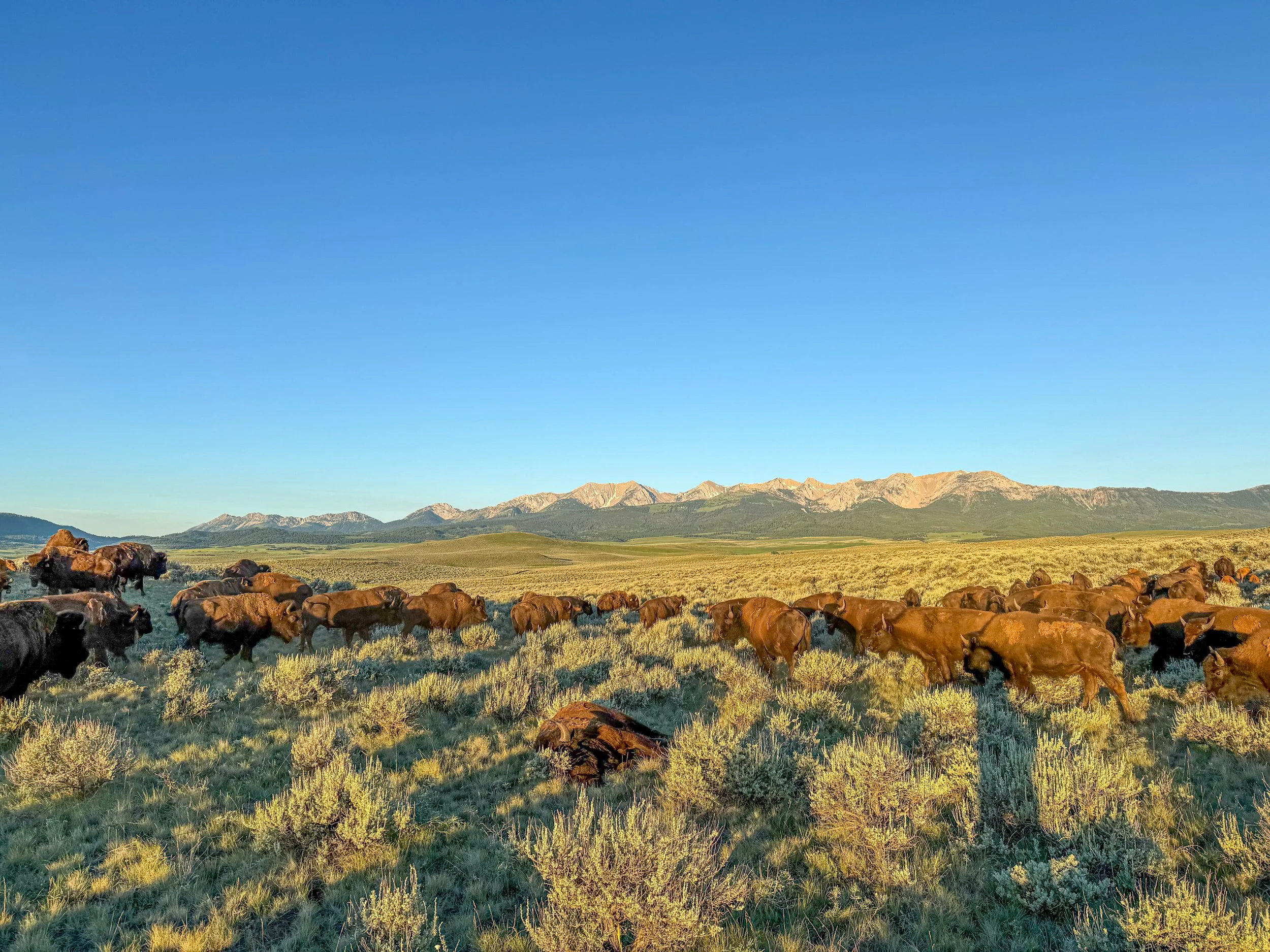
Last week I wrote in our e-mail newsletter about the powerful moment of opening the gate on Tuesday to let our bison herd run onto our newly leased land.
Land that was home to bison for thousands of years — but hasn’t felt the thundering hooves of bison in well over a century.
A night or two before I opened the gate, I happened to read the chapter “Witness to the Rain” in Braiding Sweetgrass by Robin Wall Kimmerer.
In it, Kimmerer writes about rain and time.
Like so much of the book, her writing made my brain bend in ways I love — forcing me to reconsider my human-centric view of the world.
In this case, it was her writing about time — a simple thing I take for granted and don’t think a lot about on a daily basis.
There are 60 minutes in an hour, 24 hours in a day, seven days in a week, 365 days in a year.
As Otto and Greta would say, “Easy peasy lemon squeezy.”
But not so fast.
That’s human time — our way of neatly dividing the year into simple numbers that make sense to us and bring order to our chaotic world.
But what about everything else on Earth?
Kimmerer writes:
Time as objective reality has never made much sense to me. It’s what happens that matters. How can minutes and years, devices of our own creation, mean the same thing to gnats and to cedars? Two hundred years is young for the trees whose tops this morning are hung with mist. It’s an eye-blink of time for the river and nothing at all for the rocks. The rocks and the river and these very same trees are likely to be here in another two hundred years, if we take good care. As for me, and that chipmunk, and the cloud of gnats milling in a shaft of sunlight — we will have moved on.
That paragraph hit me hard, and I simply can’t stop thinking about it.
It’s made me question the simple bison story we’ve all been told.
(There once were a lot of bison in North America, then the westward expansion of America pushed bison to the brink of extinction, and now we are slowly bringing them back. Easy peasy lemon squeezy.)
I think about the history of bison and the history of Indigenous people a lot.
I tell “The Bison Story” all the time.
I wonder what it would have been like to see tens of millions of bison in North America.
But I know that’s a thing of the past, and there’s no one alive today that witnessed it.
And then I read that passage — and I opened a gate that let bison wander onto land that used to be their home — and my brain won’t stop spinning.
While no humans alive today remember bison being on that land 150 years ago, do the cottonwood trees along the creek to the south remember the bison?
Do the sagebrushes remember?
Do the roots of the grasses remember the bison?
Does the sky remember the bison?
The sun?
The moon?
Surely someone must remember.
I opened the gate on Tuesday, and early Thursday morning I field-harvested a bison on the new land.
It was the first bison to die out there in a long time, and I can’t stop thinking about that bison’s bright red blood on the land in the soft morning light.
Does the soil remember the blood of the bison that used to nourish it?
Birds don’t live — according to human time — very long lives, but is there something in the raven’s brain that remembers?
What about the coyotes?
My human brain doesn’t know the answers to the questions.
But my animal heart knows.
It knows that there are living things out on that land that remember the great herds of bison that used to pass through there.
I know it with absolute and total certainty.
And it makes my heart happy.
— Matt